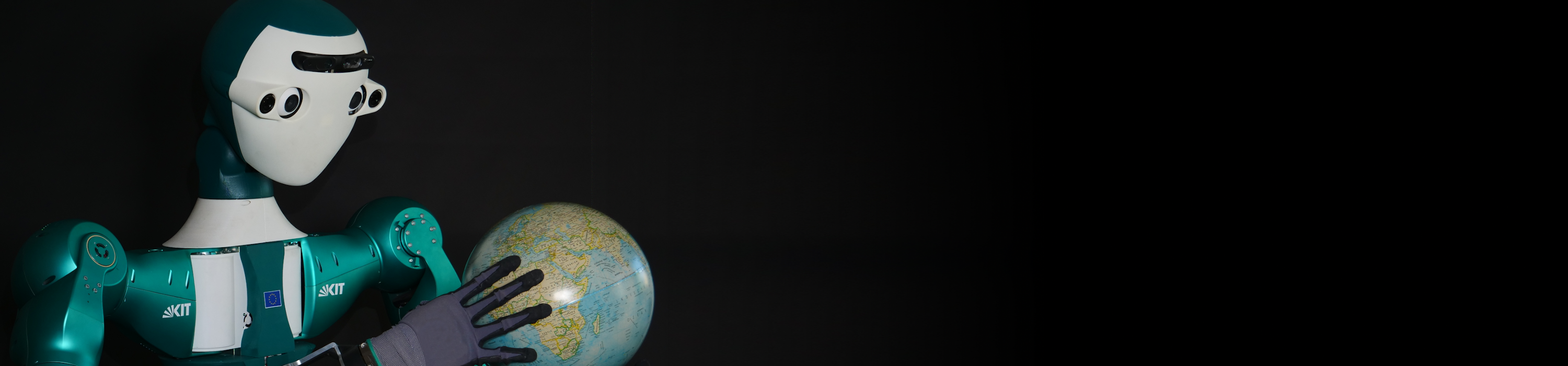
Research at H²T
The development of cognitive robots relies on artificial embodiments having complex and rich perceptual and motor capabilities. This leads to humanoid robots as the most suitable experimental platform. While simpler robotic systems might be more suitable for testing some theories in simplified environments, only humanoid robots can provide rich sensorial inputs and complex actions necessary to develop higher cognitive processes. The design of such robots which are capable of developing perceptual, behavioural and cognitive categories in a measurable way and are capable of communicating and sharing these with humans and other artificial agents is a challenging task. The target system is supposed to interact with humans in a reliable and safe manner. In particular, it is meant to be able to cooperate and to enter a dialogue with them. Therefore it needs to understand both what it perceives and what it does.
Our research interest is the development of humanoid robots which safely coexist with humans, interactively communicate with humans and usefully manipulate objects in human-centered environments. In particular, we address the integration of motor, perception and cognition components such as multimodal human-humanoid interaction and cooperation in order to be able to demonstrate robot manipulation and grasping tasks.
Regardless of the application area, one of the common problems tackled in humanoid robotics research is the investigation towards understanding of human-like information processing and the underlying mechanisms of the human brain in dealing with the real world. Our hypothesis is that such understanding can only be attained if we consider the human in the loop.
To demonstrate the feasibility of our approach, we are building humanoid robot systems with complex and rich sensorimotor capabilities as the most suitable experimental platform for studying cognitive information processing. We present our recent work that combines various approaches and techniques toward the realization of fully integrated humanoid robots performing grasping and manipulation tasks in human-centered environments and real-world scenarios. We believe that a holistic approach is fundamental to achieve this goal. Therefore, we are investigating how different partial results, attained in sub-disciplines related to the development of humanoids, fit together to obtain complete processing models and integrative system architectures, and how to evaluate results at system level rather than focusing on the performance of component algorithms.
Key Research Areas
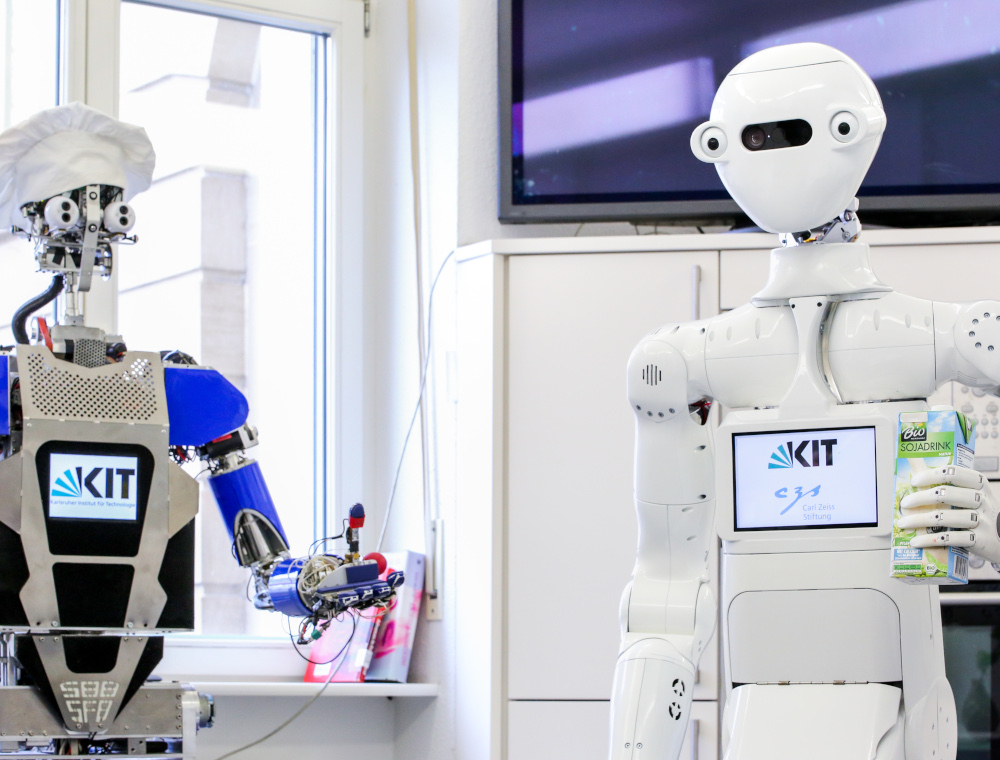 |
Integrated Humanoid Platforms The research activities in this area include the specification and design of humanoid components, the development of dedicated hardware for sensory data processing and motor control as well as the design of software frameworks, which allow for the integration in humanoid robots that are in rich in sensory and motor capabilities. |
 |
Grasping and Manipulation
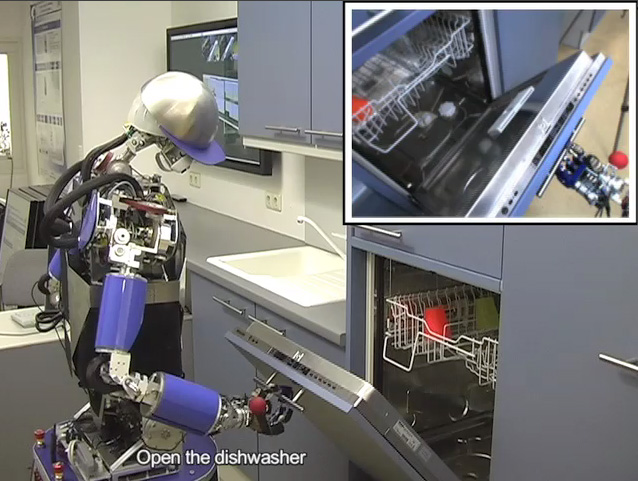
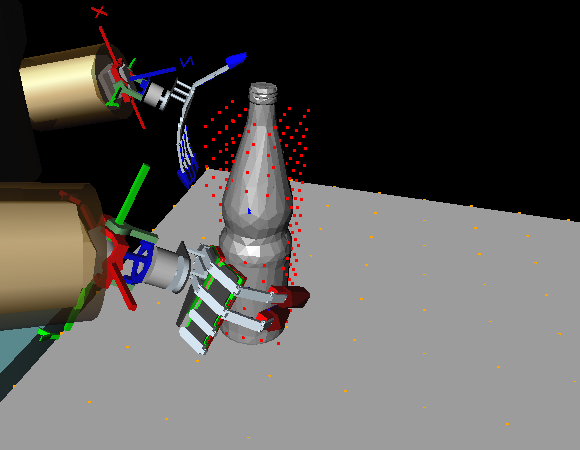
Integrated apporaches for the three main tasks needed for grasping and manipulation: grasp planning, solving the inverse kinematics for redundant manipulators and planning of collision-free motions. The algorithms are evaluated in simulation and on our humanoid robots. |
 |
Learning from Human Observation
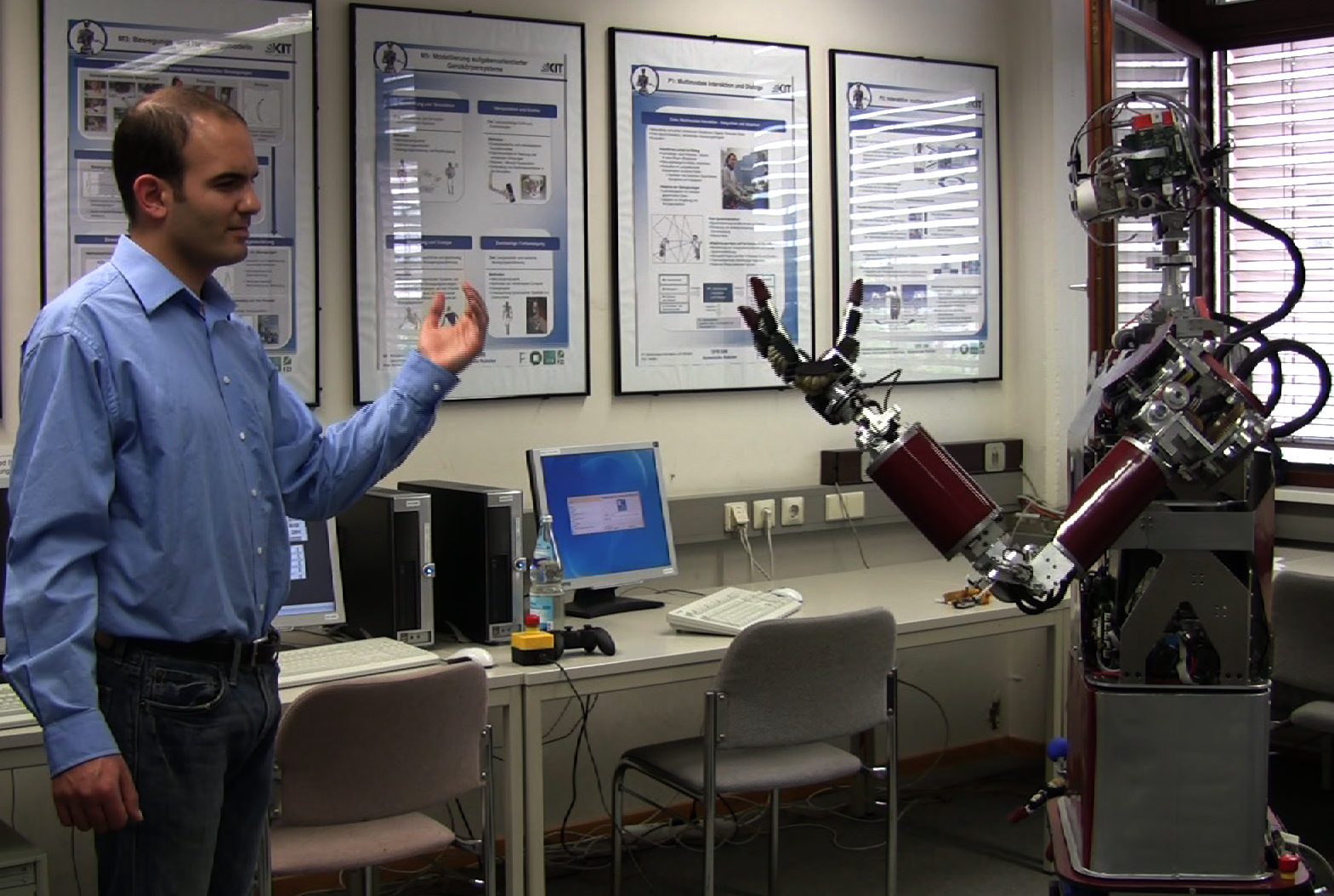
A key question in the field of humanoid robotics is how a robot can acquire skills autonomously in order to cope with daily tasks in a human-centered environment. Based on the observation of the human we develop methods, which allows the learning of these skills by imitation. |
 |
Vision The research topics in this area are concerned with on-board robot vision as the primary sensorial channel to perceive the world and endow humanoid robots with the ability to adapt to changing environments. Currently, methods and techniques for object recognition and localization, self-localization, visual servoing and markerless tracking are investigated. |
 |
Exploration Humanoid Robots are supposed to constantly and autonomously expand their knowledge base by exploration of their environment. The focus of this research topic lies on haptical and visual exploration strategies that enable a robot to create representations of unknown objects. Ultimately, the representations will enable the robot to grasp and manipulate these objects. More information |
Projects
 |
The H²T research group is involved in projects supported by the Federal Ministry of Research, Technology and Space (BMFTR), the German Research Foundation (DFG), the European Union (EU), and many other organisations. More Information |