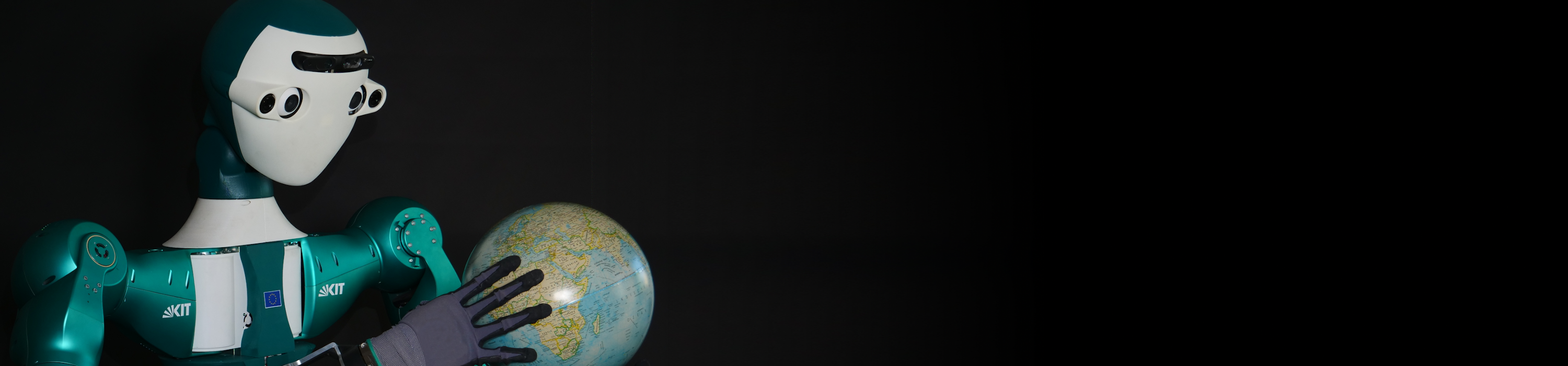
Robotics II: Humanoid Robotics
- type: Lecture (V)
- chair: KIT Department of Electrical Engineering and Information Technology
- semester: SS 2026
-
time:
Mon 2026-04-27
09:45 - 11:15, weekly
50.34 Raum -101 (UG)
50.34 INFORMATIK, Kollegiengebäude am Fasanengarten (1. Untergeschoss)
Mon 2026-05-04
09:45 - 11:15, weekly
50.34 Raum -101 (UG)
50.34 INFORMATIK, Kollegiengebäude am Fasanengarten (1. Untergeschoss)
Mon 2026-05-11
09:45 - 11:15, weekly
50.34 Raum -101 (UG)
50.34 INFORMATIK, Kollegiengebäude am Fasanengarten (1. Untergeschoss)
Mon 2026-05-18
09:45 - 11:15, weekly
50.34 Raum -101 (UG)
50.34 INFORMATIK, Kollegiengebäude am Fasanengarten (1. Untergeschoss)
Mon 2026-06-01
09:45 - 11:15, weekly
50.34 Raum -101 (UG)
50.34 INFORMATIK, Kollegiengebäude am Fasanengarten (1. Untergeschoss)
Mon 2026-06-08
09:45 - 11:15, weekly
50.34 Raum -101 (UG)
50.34 INFORMATIK, Kollegiengebäude am Fasanengarten (1. Untergeschoss)
Mon 2026-06-15
09:45 - 11:15, weekly
50.34 Raum -101 (UG)
50.34 INFORMATIK, Kollegiengebäude am Fasanengarten (1. Untergeschoss)
Mon 2026-06-22
09:45 - 11:15, weekly
50.34 Raum -101 (UG)
50.34 INFORMATIK, Kollegiengebäude am Fasanengarten (1. Untergeschoss)
Mon 2026-06-29
09:45 - 11:15, weekly
50.34 Raum -101 (UG)
50.34 INFORMATIK, Kollegiengebäude am Fasanengarten (1. Untergeschoss)
Mon 2026-07-06
09:45 - 11:15, weekly
50.34 Raum -101 (UG)
50.34 INFORMATIK, Kollegiengebäude am Fasanengarten (1. Untergeschoss)
Mon 2026-07-13
09:45 - 11:15, weekly
50.34 Raum -101 (UG)
50.34 INFORMATIK, Kollegiengebäude am Fasanengarten (1. Untergeschoss)
Mon 2026-07-20
09:45 - 11:15, weekly
50.34 Raum -101 (UG)
50.34 INFORMATIK, Kollegiengebäude am Fasanengarten (1. Untergeschoss)
Mon 2026-07-27
09:45 - 11:15, weekly
50.34 Raum -101 (UG)
50.34 INFORMATIK, Kollegiengebäude am Fasanengarten (1. Untergeschoss)
- start: 27.04.2026
- lecturer: Prof. Dr.-Ing. Tamim Asfour
- sws: 2
- lv-no.: 2400074
- information: On-Site
| Content |
This lecture addresses the implementation of complex sensorimotor and cognitive abilities in humanoid robots, with humans serving as inspiration. The lecture begins by addressing the motivation for humanoid robotics. The history of humanoid robotics and biomechanical models of the human body that inform robot design are covered, along with some mechatronic principles underlying humanoid robot systems. The first main topic comprehensively addresses grasping and manipulation. After covering fundamentals, the lecture discusses neuroscientific insights and concepts like grasp phases and grasping synergies to reduce control complexity. Taxonomies are presented as structured frameworks for understanding the space of possible constraints in grasping and manipulation. The lecture addresses computational approaches for grasping known, familiar, and unknown objects, covering both classical methods and modern learning-based approaches using deep learning and vision-language-action models. The second main topic covers learning from demonstration and imitation learning. After introducing the topic, fundamentals are presented including the learning from demonstration cycle. The lecture emphasizes learning task models on both symbolic/semantic and subsymbolic/sensorimotor levels. While methods for capturing human demonstrations are briefly covered, the focus is on semantic segmentation of human demonstrations and learning of task constraints that capture the task and allow generalization. Movement primitives are presented as efficient representations that allow robots to generalize learned behaviors to new situations. The lecture concludes with cognitive and AI-based architectures for humanoid robots, discussing state-of-the-art approaches, methods to address the signal-to-symbol gap, and human-inspired memory architectures that enable intelligent robot behavior. Learning Objectives: Students can explain the challenges and goals of humanoid robotics research, particularly regarding the implementation of complex sensorimotor and cognitive abilities in humanoid robots. They are familiar with the history of the field and understand how biomechanical models of the human body inform humanoid robot design. Students have comprehensive knowledge of human and robotic grasping and manipulation. They can analyze human grasping and manipulation strategies, understand taxonomies, and evaluate different computational approaches for grasping and manipulation. They understand the challenges in transferring concepts from human studies to humanoid robots. Students understand fundamentals of learning from human demonstration and imitation learning. They can explain the learning from demonstration cycle and methods for learning generalized task representation, especially task constraints from demonstrations, and how learned behaviors are reproduced on robots. Students can describe cognitive and AI-based architectures for humanoid robots, including approaches to address the signal-to-symbol gap and human-inspired memory architectures that enable intelligent robot behavior. |
| Language of instruction | English |
| Bibliography |
Additional literature Scientific publications on the topic are made available on the lecture website. |
| Organisational issues |
Please note that this course starts in the second week of the semester, on 27.04.2026. The assessment is carried out as a written examination (§ 4 Abs. 2 No. 1 SPO) of, in general, 60 minutes. Recommendations Workload:
|