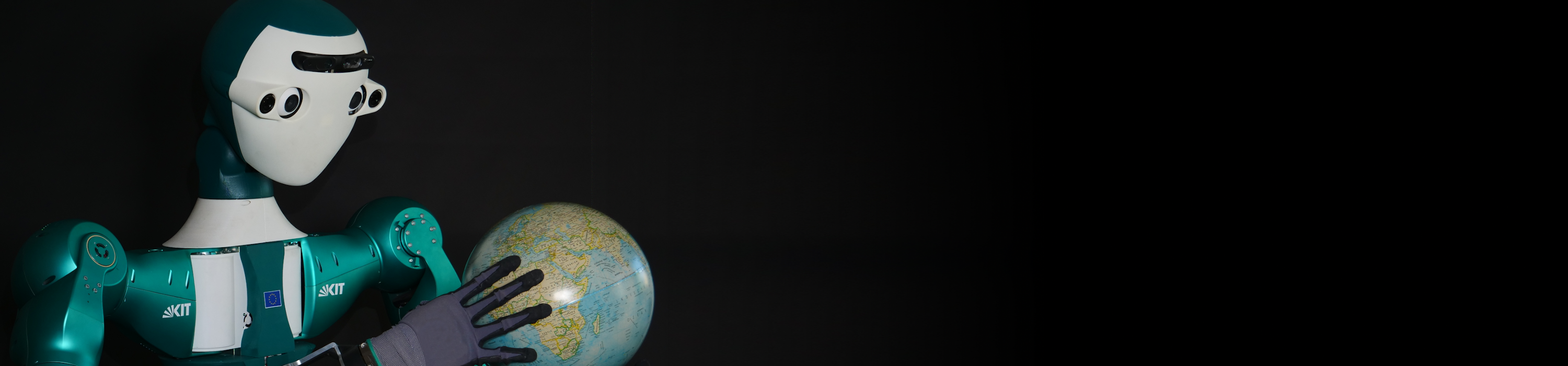
Wearable Robotic Technologies
- type: Lecture (V)
- chair: IAR Asfour
- semester: SS 2026
-
time:
Mon 2026-04-27
11:30 - 13:00, weekly
50.34 Raum -102 (UG)
50.34 INFORMATIK, Kollegiengebäude am Fasanengarten (1. Untergeschoss)
Mon 2026-05-04
11:30 - 13:00, weekly
50.34 Raum -102 (UG)
50.34 INFORMATIK, Kollegiengebäude am Fasanengarten (1. Untergeschoss)
Mon 2026-05-11
11:30 - 13:00, weekly
50.34 Raum -102 (UG)
50.34 INFORMATIK, Kollegiengebäude am Fasanengarten (1. Untergeschoss)
Mon 2026-05-18
11:30 - 13:00, weekly
50.34 Raum -102 (UG)
50.34 INFORMATIK, Kollegiengebäude am Fasanengarten (1. Untergeschoss)
Mon 2026-06-01
11:30 - 13:00, weekly
50.34 Raum -102 (UG)
50.34 INFORMATIK, Kollegiengebäude am Fasanengarten (1. Untergeschoss)
Mon 2026-06-08
11:30 - 13:00, weekly
50.34 Raum -102 (UG)
50.34 INFORMATIK, Kollegiengebäude am Fasanengarten (1. Untergeschoss)
Mon 2026-06-15
11:30 - 13:00, weekly
50.34 Raum -102 (UG)
50.34 INFORMATIK, Kollegiengebäude am Fasanengarten (1. Untergeschoss)
Mon 2026-06-22
11:30 - 13:00, weekly
50.34 Raum -102 (UG)
50.34 INFORMATIK, Kollegiengebäude am Fasanengarten (1. Untergeschoss)
Mon 2026-06-29
11:30 - 13:00, weekly
50.34 Raum -102 (UG)
50.34 INFORMATIK, Kollegiengebäude am Fasanengarten (1. Untergeschoss)
Mon 2026-07-06
11:30 - 13:00, weekly
50.34 Raum -102 (UG)
50.34 INFORMATIK, Kollegiengebäude am Fasanengarten (1. Untergeschoss)
Mon 2026-07-13
11:30 - 13:00, weekly
50.34 Raum -102 (UG)
50.34 INFORMATIK, Kollegiengebäude am Fasanengarten (1. Untergeschoss)
Mon 2026-07-20
11:30 - 13:00, weekly
50.34 Raum -102 (UG)
50.34 INFORMATIK, Kollegiengebäude am Fasanengarten (1. Untergeschoss)
Mon 2026-07-27
11:30 - 13:00, weekly
50.34 Raum -102 (UG)
50.34 INFORMATIK, Kollegiengebäude am Fasanengarten (1. Untergeschoss)
- start: 27.04.2026
-
lecturer:
Prof. Dr.-Ing. Tamim Asfour
Prof. Dr.-Ing. Michael Beigl - sws: 2
- ects: 4
- lv-no.: 2400062
- exam: To be announced soon
- information: On-Site
| Content |
The lecture provides a comprehensive introduction to wearable robotic technologies. It covers human anatomy and biomechanics as foundations for wearable robot design. Joint biomechanics, locomotion and gait analysis, the neuromuscular system, and models of the human body are discussed to understand how wearable robots can be designed and controlled. Design principles and mechanisms of wearable robots are addressed. Actuation technologies are covered in depth: requirements analysis based on human motion and user needs, compliant actuation approaches (serial elastic, parallel elastic, variable stiffness actuation), and strategies for increasing efficiency such as energy harvesting, multi-articulation, and underactuation. The lecture covers wearable computing principles such as body signals and phenomena, design principles for body-worn systems, attachment considerations based on body maps for heat tolerance, weight distribution, and flexibility, and fabric design with textile-embedded electronics. Exoskeleton systems are presented, covering application areas, design challenges such as redundancy, kinematic compatibility, and misalignments, various types of exoskeletons, and the general design process. Prosthetic systems cover types of hand and lower limb prostheses, hand synergies for control, and mechanical interfaces through socket design. Human-robot interaction addresses both physical and cognitive interfaces. Control strategies are presented for prosthetic systems (semi-autonomous grasping) and exoskeleton systems (hierarchical control, assistance evaluation). The concept of body schema from both neuroscience and robotics perspectives is discussed, emphasizing symbiotic human-machine interaction in tightly coupled wearable systems. State-of-the-art examples across various application domains illustrate current research and developments. Learning Objectives: Students can explain the fundamentals, motivation, and applications of wearable robotic technologies including exoskeletons, orthoses, and prostheses. They have comprehensive knowledge of human anatomy, biomechanics, and the neuromuscular system relevant to wearable robot design. Students understand the core components and challenges associated with the design of wearable robotic technologies, including mechanisms, actuation technologies, sensing approaches, and wearable computing concepts. They can analyze design requirements and challenges including kinematic compatibility and human-robot interfaces for wearable robots. Students can explain control strategies for prosthetic and exoskeleton systems, understand both physical and cognitive aspects of human-robot interaction, and comprehend concepts such as body schema and symbiotic human-machine interaction in wearable systems. |
| Language of instruction | English |
| Bibliography |
Lecture slides and selected current literature references will be given in the lecture and made available in ILIAS. |
| Organisational issues |
Please note that this course starts in the second week of the semester, on 27.04.2026. Sucess is assessed in the form of a written examination, usually lasting 60 minutes in accordance with § 4 (2) No. 1 SPO Workload:
|